
The Phantom Barber: Creepy Midnight Hair Thief Of Mississippi
Checking out the bizarre 1942 true crime mystery of Pascagoula's midnight hair thief, who left a town in terror.

Any bizarre crime from history series can’t overlook the story of the Phantom Barber. It all went down in 1942 and at the time, someone in Pascagoula, Mississippi, kept entering homes at night.
He didn’t take money. And he didn’t steal other valuables. But he did take away something extremely personal. Read on for more details.
The First Attacks
Most accounts presume the suspect was a man, so for ease of reference, let’s presume the same thing. The story goes that he crept in and stood over sleeping folks.
Creepily, while unaware of what was going on, mostly women and kids woke up and discovered they’d had an unasked-for haircut. The culprit was never caught.
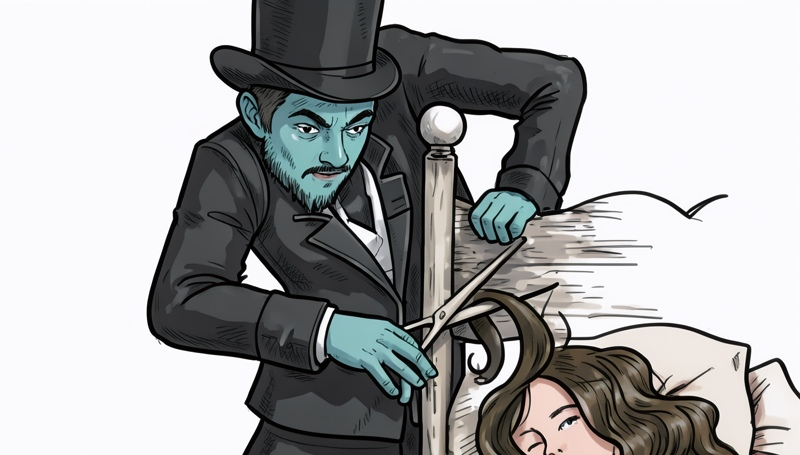
The incidents started on June 5, 1942, at the Our Lady of Victories convent. Two young girls, Mary Evelyn Briggs and Edna Marie Hydel, woke up to find a man leaving through their window.
According to contemporary news accounts, Briggs described the intruder as a “short, fat man” in a white sweatshirt.
Per @NoahTheKing on Medium, the girls discovered their own hair lying on the pillows.
A Summer of Fear
For about six weeks, the bizarre intruder returned on his hair-cutting mission inside 10 different homes.
The pattern quickly emerged, and entrance was gained by cutting a screen on windows. Then, he quietly moved around inside the homes.
The hair cutting seemed to be the only thing that he wanted to take away with him. He left everything else untouched.
Using Chloroform?
Morbidology.com noted that six-year-old Carol Peattie is another cited victim. Apparently, she awoke to find chunks of her hair missing.
Well, it certainly didn’t look as if it was styled the way most people would have hoped for.
In another incident, a woman named Mrs. R. E. Taylor told police she felt ill after an attack. So that led to some speculation that perhaps the hair-cutting victims were rendered unconscious through the use of chloroform.
What on earth motivated a man to slice off the braid of hair from one victim? Later, it was discovered just lying there on the mattress.
A Type
Information that filtered down through the years revealed a particular type that attracted the oddball barber. All of his victims were blonde, and his timetable for the bizarre outings seemed confined to Mondays and Fridays.
In response to the non-violent but oddly frightening crimes, the town formed armed patrols. Men walked the streets at night with guns.
Residents offered a reward of $300 to $500. Families sat up through the dark, taking turns staying awake while others slept.
The War Years
As the war years progressed, catching the Phantom Barber became a bit more difficult. Remember, back then towns were under blackout conditions.
Wives, sisters, daughters, and tailors ran up black curtains. Regulations didn’t permit lighting to show at night.
Well, for the hair-obsessed criminal, that only made his job much easier. After all, he could move unseen through the dark.
Ironically, the fear of the Phantom Barber overshadowed the fear of German bombs because some folks ignored the blackout regulations and left lights on outside.
An Arrest
In August 1942, police arrested a chemist. William A. Dolan, 57, spent his educational years in Germany. Ironically, he faced charges of breaking and entering and aggravated assault with an iron pipe.
Not a single hair was stolen from his victims, Mr. and Mrs. Terrell Heidelberg.
Nevertheless, police officers found some hair close to Dolan’s home. Hardly enough evidence to convict him for that.
But inquiring minds might wonder why the hair thief stopped his activities during the incarceration of Dolan, who served time for attempted murder.
Notably, he wasn’t convicted for the snipping of slumbering locks. Denial that he was the Phantom Barber persisted and, in 1951, following a lie detector test, he resumed his life after his release.
An Unsolved Mystery
The real Phantom Barber was never found. He might have moved away. Potentially, he might have been a victim of crime. Or, the arrest of Dolan might have given him pause and time to reflect on his absurd predilection.
What are your thoughts? Was William Dolan guilty? Let us know in the comments below, and come back here often for all your bizarre true crime stories from history.
